Are you wondering how to dispose of pesticides in Jacksonville? If so, you’re not alone. Sure, it’s a fairly esoteric subject, but an important one because that stuff isn’t just ordinary household waste. No sir. Some of it is downright dangerous. And it can be even more harmful if you’re not careful with what you do with it, when you do it, and perhaps the biggest factor is where you do it. This is because what you do with leftover pesticides and empty containers here in Duval County matters a lot. Believe it or not, your actions have a much bigger impact than you might think. So, let’s look at how you should handle leftover pesticides and empty containers in Jacksonville and beyond.
Managing Household Hazardous Waste
Here’s the root problem with managing pesticides and their empty containers in Duval County: these things require actual care and, due to local rules, cannot be thrown out with regular curbside trash. This means residents can’t simply dump everything in one big bin to be picked up and whisked away. The reason is fairly obvious and straightforward: household hazardous waste, or HHW, is just that, hazardous. Consequently, it’s in a category of its own and, as a result, requires different disposal methods, and this begins with residents, putting the onus on them.
Proper Disposal of Leftover or Unused Pesticides
Now, you wouldn’t dare leave rubbing alcohol or prescription drugs out for anyone in the house to get into, especially children and pets. You know these can be very harmful substances and particularly injurious to your furry friends and babies. Pesticides and the empty containers they leave behind should never be left unsecured. But these substances should also never be poured down the drain, either. You should also never pour pesticides down the toilet, into the tub or shower drain, or directly onto the ground. Instead, be responsible and do the right thing. You can drop these items off for free at 2675 Commonwealth Avenue in Jacksonville. (The facility is open Monday through Saturday from 8 am until 5 pm.)
Fortunately, the city of Jacksonville also hosts periodic events. These are mobile disposal machines, and you can find their operating times on the city’s official website under “Solid Waste” by going to Departments > Office of Administrative Services > Solid Waste.
Empty Pesticide Containers
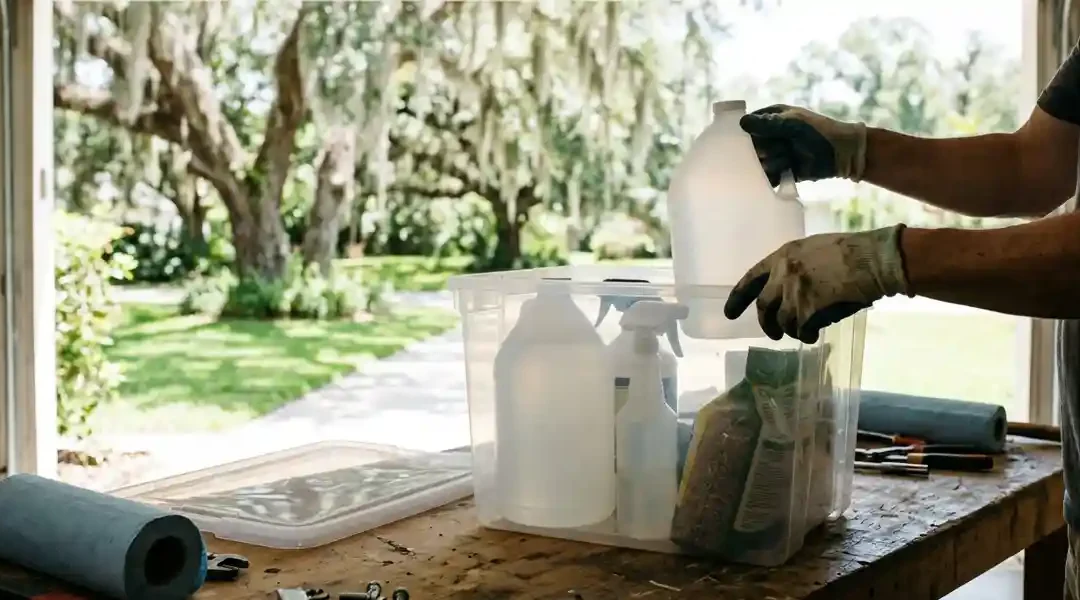
Okay, the problem with empty containers is what is or isn’t still inside. If they are just rinsed out, rather than completely empty, you’ll need to treat them differently, because, well, they are, in fact, different. If it’s an empty or near-empty liquid container, you should use the triple-rinse method, which is precisely what it sounds like. Pour any remaining liquid out of its container into the spray bottle you use to apply it to your landscaping. Then, fill the container about one-quarter full with clean water, close the lid, shake thoroughly, and pour the rinsed mixture back into your spray tank. Repeat this process three times total, then puncture the container and wrap it in a plastic trash bag for recycling. If it’s an aerosol can, make sure it’s fully empty. Once the contents are depleted, it’s often all right to just put it in your regular trash receptacle.
Now, if it’s a dry container, such as a bag or box, you’ll need to shake out all remaining dry material into your applicator according to product directions. Put the empty bag or box in a plastic trash bag and place it in your regular trash. But don’t let it linger in your house. Instead, put it in a large garbage bin on your curb for pickup on your regular collection day.
Best Safety Practices
Because pesticides and their containers are inherently dangerous, handle them carefully and dispose of them properly. First, always be sure to keep the products in their original packaging, whether liquid containers or dry bags and boxes, with their labels intact as much as possible. Keeping the labels on the packaging allows waste facility workers to identify them safely. For your own well-being, never transport pesticides or empty containers without securing them to prevent spills in your vehicle on the way to the disposal site. After all, there’s nothing good that can come from spilling any of that stuff in your car, truck, or van. Last, but certainly not least, never let children handle pesticides or their empty containers, even if those containers have been emptied and rinsed out or emptied completely.
Pesticide Disposal FAQs
What other household hazardous waste does Jacksonville accept?
Jacksonville’s household hazardous waste program accepts many common home chemicals besides pesticides, including paint, motor oil, pool chemicals, batteries, fluorescent bulbs, and cleaning products. Check the city’s Solid Waste page for the current list before you go, since accepted items and quantity limits can change.
Do I need proof of residency to drop off hazardous waste in Duval County?
Yes, you should plan to show proof that you live in Duval County, such as a driver’s license or a recent utility bill. The free drop-off program is meant for residents disposing of household quantities. If you live in Clay or St. Johns County, use your own county’s hazardous waste collection site instead.
Do pesticides expire?
Yes, most pesticides lose effectiveness over time, and many have a shelf life of about two years once opened. Heat, moisture, and freezing can break them down faster. If a product has separated, clumped, or crystallized, or you can’t read the label anymore, it’s safest to take it to a hazardous waste drop-off.
How should I store pesticides in a Florida garage?
Store pesticides in their original containers on a high, locked shelf, away from food, pet supplies, and water heaters. Florida garages get extremely hot in summer, which can degrade products and stress containers, so keep them out of direct sun and off the floor where flooding or leaks could reach them.
What should I do if I spill pesticide at home?
Contain the spill right away by soaking it up with cat litter, sand, or paper towels while wearing gloves. Keep children and pets away, ventilate the area, and bag the cleanup materials for hazardous waste disposal. If anyone touches or swallows the product, call Poison Control at 1-800-222-1222 immediately.
Can businesses use Jacksonville’s household hazardous waste facility?
Generally, no. Jacksonville’s free household hazardous waste drop-off is meant for residents, not commercial operations. Businesses that generate pesticide waste typically need to work with a licensed hazardous waste hauler and follow state and federal disposal rules, which carry stricter recordkeeping and handling requirements than household disposal.
Can I give leftover pesticides to a neighbor instead of throwing them out?
Yes, sharing leftover pesticide is often the easiest way to avoid waste, as long as it stays in its original, clearly labeled container. Make sure the product is still legal to use, the label is readable, and your neighbor actually needs it for a pest listed on the label.