
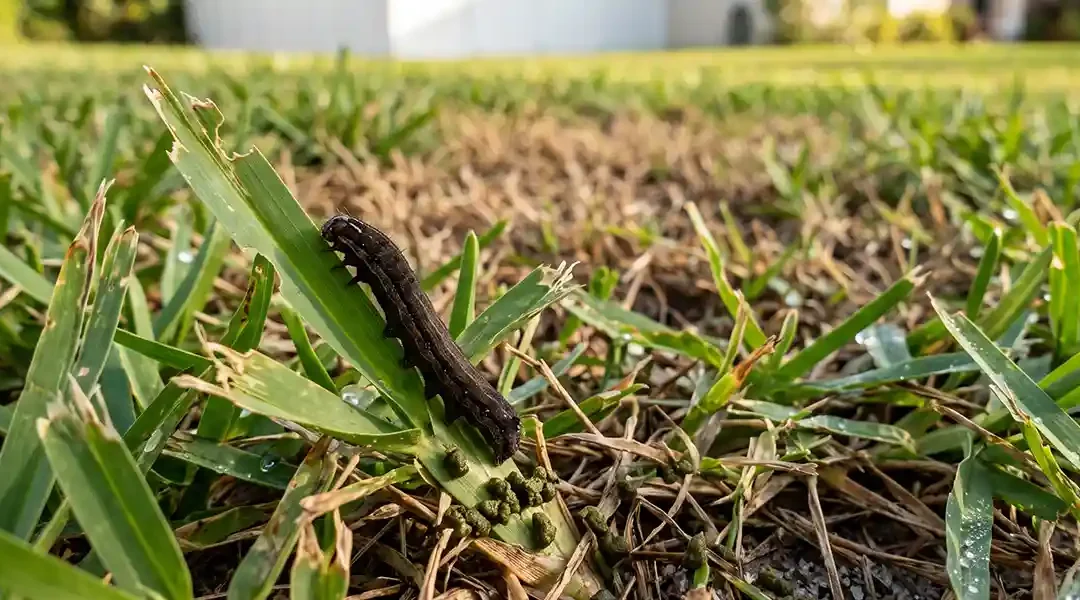
It’s a pleasant fall day in Jacksonville, and you’re out doing a little lawn work when you come across something you’ve never seen before. Brown spots in the otherwise green grass that look as though they’re expanding. What’s more, some of the grass appears gnawed, with jagged chunks missing from the blades.
Examining your lawn more closely, you start to notice more discrepancies, and then you spot tiny green or dark brown pellets. Tracing those odd spots, you discover tan or off-white fuzzy patches on the fence. But these are also present on your patio walls, and even on the soffits. So, you feed all these observations into a chatbot to get to the bottom of the mystery, and the reply hits you like a ton of bricks: “fall armyworm lawn damage.” Wait? What? Fall armyworm? Who’s ever heard of such a thing? Disturbed by the explanation, you begin to dig a little deeper to learn more. Here’s what you’ll soon find.
What are Fall Armyworms, Anyway?
The fall armyworm, known in the scientific community as “Spodoptera frugiperda,” is an extremely destructive agricultural pest that’s native to the Americas and is actually a caterpillar, not a worm. (Final Jeopardy winning answer you can keep in your back pocket if you’re ever on the show.) But true to their name, armyworms march en masse across fields and pastures like a destructive battalion, leaving no greenery behind.
More particularly, the fall armyworm is the larval stage of a grayish-brown migratory moth. Females lay their eggs (which look like fuzzy, moldy clusters) on leaves or attached to fences, exterior walls, soffits, and more. Once hatched, these things eat voraciously for 2 to 3 weeks straight, causing widespread damage to lawns, crops, gardens, and plenty more.
Key Identifying Features
All right. So, now you’re pretty sure there are fall armyworms invading your lawn. Armed with this new info, you slowly walk across the grass, looking for these elusive creatures. By now, you know they’re about a half inch to an inch and a half long, depending on their age. The young are, of course, the smallest, while the biggest are the most mature. You’re looking for something that’s dull, perhaps a dark brown, or even almost black, that sports a very distinctive, upside-down yellow “Y” on the top of its head, and stripes along its back.
Behavior and Damage
Unfortunately, if this is your first introduction to this particular pest, you probably don’t know just how destructive it can be. Sure, you know termites will eat your house whole and usually chew through a big portion before you even know they’re present or have any hint of a problem. Fall armyworms absolutely devour turfgrass, lawns, and ornamental landscaping. Worse still, Jacksonville is the ideal climate for the rice strain of this pest, so they are naturally drawn to your lawn. Sadly, it doesn’t end there. Fall armyworms love Jacksonville for its abundance of golf courses, commercial turf, and even its rural areas. Making matters worse is the fact that once present, they work very quickly, and that gives you little time to effectively deal with them after they’ve invaded your lawn.
How to Confirm an Active Fall Armyworm Infection
Now that you know a lot more about the fall armyworm, it’s time to confirm this is the actual pest you’re dealing with. But how do you do that? Well, it’s not as difficult as you might think. All you need is a few common household items and about 15 minutes.
Simply grab a bottle of dish soap and a bucket. Then, pour 2 tablespoons of that liquid dish soap into a gallon of water inside the bucket. Stir the contents to mix the soap with the water, and then find a patch of brown grass. Slowly pour the soapy water between the patch of brown grass and healthy grass. Wait about 5 to 10 minutes, carefully watching for upward movement. If armyworms are present, they’ll become irritated and crawl to the top of the grass. Voilà! You’ll know if you’re dealing with fall armyworms.
Now, to determine if there’s enough to cause an actual problem, repeat the same process and start counting. Do this about three to four times, and if you spot 3 to 4 worms per square foot, it’s highly likely you’ve got a bigger problem than you realize. So, get help quickly, before they multiply further and start wreaking havoc on your lawn. If you’re still not quite sure there are enough present in your grass to cause a problem, seek the help of a local professional pest control service. In the meantime, monitor your lawn to see if new brown patches appear and if more of their fuzzy, moldy-looking eggs begin to appear on your fence, soffits, and/or exterior walls of your home.