
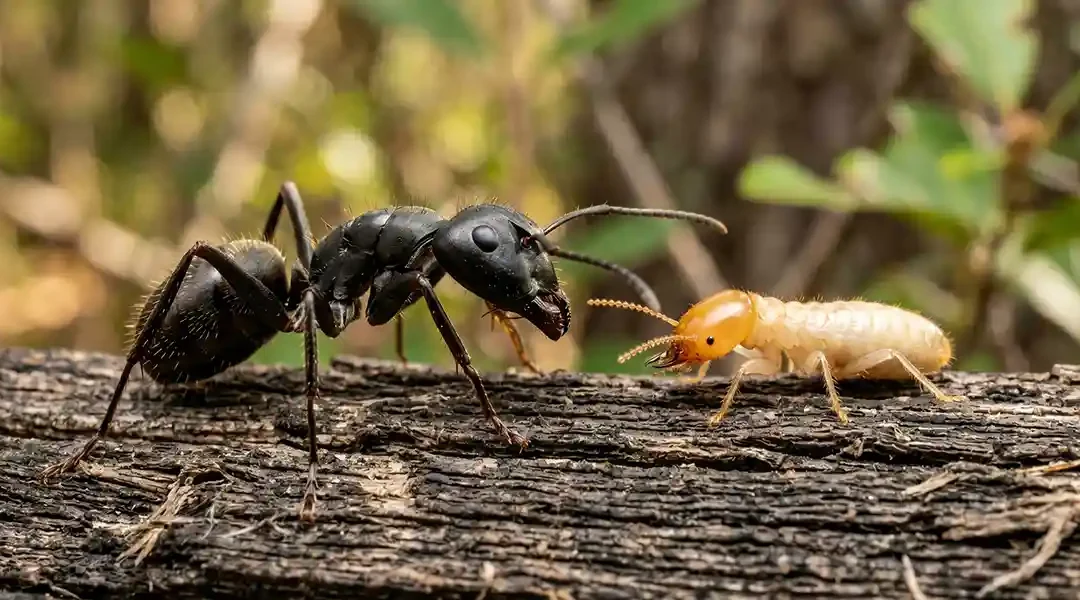
The battle of household pests is a constant one, and few matchups are as commonly misunderstood as ants versus termites. These tiny intruders may look similar at first glance—especially during swarm season—but their behavior, damage potential, and treatment options are vastly different, because understanding the difference is key to protecting your home and property.
Here’s a detailed breakdown of how ants and termites compare—and what you should do if you suspect an infestation.
The Key Differences Between Ants and Termites
Though they’re both social insects that live in large colonies, ants and termites are biologically distinct species. Telling them apart begins with understanding how they look and behave.
1. Physical Appearance
When you spot a swarm—especially in the spring or early summer—it’s easy to confuse flying ants with termites. But a closer look can reveal the difference:
- Ants have elbowed antennae, a pinched waist (think hourglass figure), and front wings that are noticeably longer than their back wings.
- Termites have straight antennae, a thick waist, and four wings of equal length that are often longer than their body.
You’ll often find discarded wings near windowsills or baseboards, which can provide another clue as to which pest has entered your home.
2. Behavior and Diet
Ants and termites may both invade your space, but they do so with very different goals:
- Ants, particularly carpenter ants, nest in wood but do not eat it. They hollow out galleries in damp or decaying wood to create nesting sites.
- Termites, on the other hand, eat wood, paper, and anything made of cellulose. Subterranean termites—the most common in Florida—build mud tubes to travel between their underground colonies and above-ground food sources.
In short, ants might be a nuisance, but termites are out to destroy.
Signs of an Infestation
Identifying the early signs of an infestation can save Jacksonville homeowners thousands of dollars in repairs.
Ant Infestation Signs:
- Visible trails of ants, especially near food or water sources
- Piles of frass (a sawdust-like material) near wood structures—this is a byproduct of carpenter ants nesting
- Rustling sounds in walls, particularly at night
Termite Infestation Signs:
- Discarded wings near windows and doors
- Mud tubes along foundation walls or inside crawl spaces
- Hollow-sounding or damaged wood, especially around windows, baseboards, or floors
- Blistering paint or small pinpoint holes in drywall
Because termites work silently, damage often goes unnoticed until it becomes severe. That’s why early detection is critical.
The Risks: Ants vs. Termites
The real difference comes down to the damage these pests can cause:
- Ants, while annoying and sometimes invasive, typically do not cause structural damage—unless you’re dealing with carpenter ants. Even then, the harm is more localized and slower to develop.
- Termites, however, can silently devour wooden beams, floor joists, and support structures. In fact, the National Pest Management Association estimates termites cause more than $5 billion in property damage each year—and most of it isn’t covered by homeowners insurance.
In Florida’s warm, humid climate, subterranean termites thrive and are active year-round, making Jacksonville homes especially vulnerable.
How Trad’s Pest Control Can Help
Whether you’re dealing with ants, termites, or both, the experts at Trad’s Pest Control are ready to help you reclaim your home with proven, environmentally responsible solutions.
Termite Control:
- Inspection. Our trained technicians conduct a thorough inspection of your home, including crawlspaces, attics, and foundations.
- Treatment. We offer a variety of treatment options, including liquid termiticides and baiting systems.
- Prevention. We focus not only on eliminating current infestations but also on preventing future damage with ongoing monitoring and protective barriers.
Ant Control:
- Targeted treatments. Depending on the species, we use baiting, barrier treatments, or direct nest applications to eliminate the colony.
- Entry point sealing. We identify and seal common entry points to keep ants out for good.
- Ongoing monitoring. For homes with recurring ant problems, we offer year-round pest control plans for peace of mind.